The people who persistently protect the forest in Lieng Sronh create OCOP-certified incense
Fortyfying the global supply chain has brought optimistic changes to Viet Nam industrial real estate market / Organizations detecting ransomware decline as the volume and impact of targeted attacks continue to rise
The dream of agarwood in the impoverished forest land
Amidst the hills of Lieng Sronh, Dam Rong 2 commune (Lam Dong province), the agarwood plantations today are not just the green of a raw material area. They also bear the traces of many years of hard work in the forest, numerous failures, and the perseverance of Mr. Hoang Duy Thanh – the man who chose the agarwood tree to begin his journey of producing pure agarwood under the forest canopy.
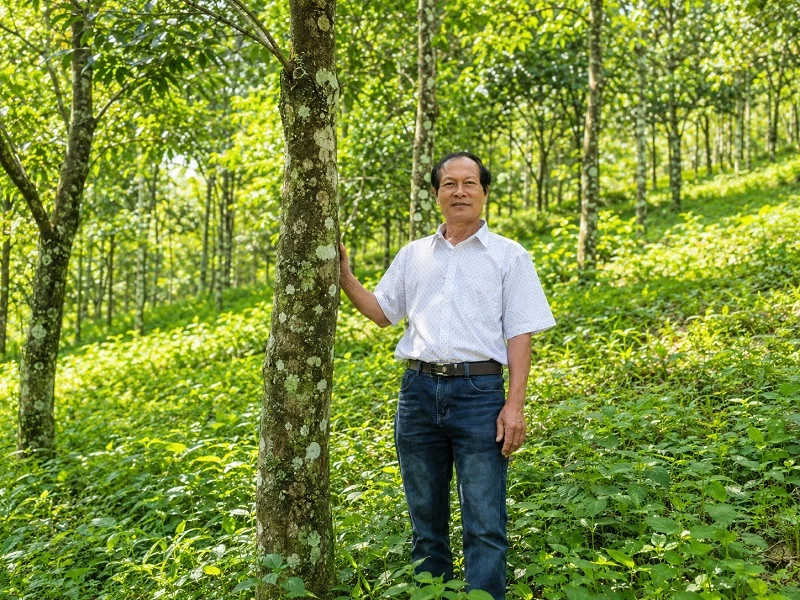
Mr. Hoang Duy Thanh - Quang Nam Agarwood Joint Stock Company, next to an agarwood forest in Lieng Sronh.
Upon arriving in Liêng Srônh, amidst the mountainous forests of Đam Rông, Mr. Thành realized that the climate, water resources, soil, and ecosystem of the area were suitable for cultivating agarwood trees. Seeing an opportunity is one thing, but seeing it through to the end is another.
Recalling the beginning, Mr. Thanh admitted that he was "very reckless." At that time, he lacked experience and planted during the dry season, so many areas of newly planted trees withered and died in waves before they had a chance to take root. After each such incident, the cost of seedlings, labor, care, and the trust of the team were all eroded. For a small business in the mountainous region, failure is not only an economic loss but also a nagging question about whether to continue clinging to the forest or give up.
He chose to stay. After each tree die-off, he and his colleagues traced the causes back to the planting techniques, moisture retention methods, amount of base fertilizer, and planting timing. Poor soil, scarce water, and unpredictable weather forced them to adjust every aspect of care. These seemingly small things were repeated over many seasons, like someone learning from scratch about the forest soil.
Behind the vibrant green of today's agarwood plantations lies a long period of time marked by numerous setbacks. At one point, tens of thousands of saplings were planted only to wither and die. Capital raised from various sources lay idle on the land. The hillsides, which were thought to be recovering, reverted to their barren state. But in the face of hardship, Mr. Thanh and his colleagues did not give up. They meticulously checked each planting hole, each tree density, each amount of irrigation water, each layer of organic fertilizer, and each method of protecting the young trees.
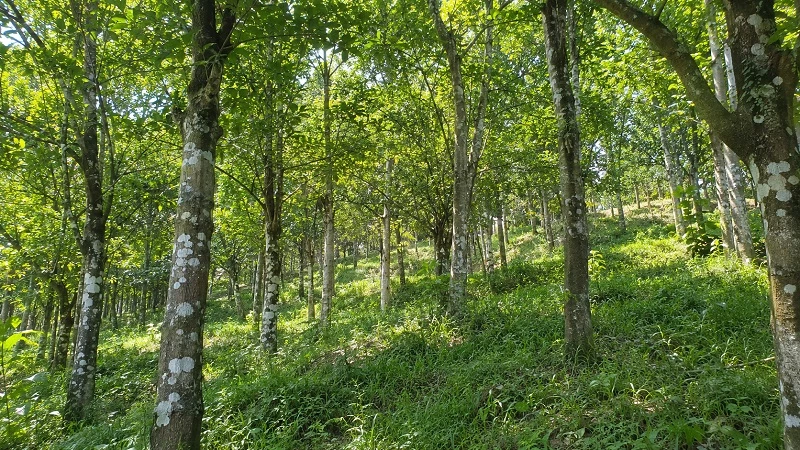
A corner of the eucalyptus forest belonging to Mr. Hoang Duy Thanh in Lieng Sronh.
It was these setbacks that shaped Mr. Thanh's perspective on forests. For him, reforestation cannot simply be about greening at all costs. Trees must survive, the soil must be preserved, the ecosystem must be nurtured, and the final product must be clean. That's also why he doesn't accept methods of producing agarwood quickly but with excessive use of chemicals. After witnessing the stripping of tree bark followed by the application of chemicals to force the trees to secrete resin, he realized he couldn't follow that path.
"I find that too cruel; the resulting agarwood isn't clean," Mr. Thanh shared. That simple statement reveals that his concern goes beyond the economic value of agarwood. For him, agarwood production is also about preserving the quality of the forest. If agarwood is produced from damage to the tree, that damage absolutely cannot be exploited in a brutal, destructive way or at the expense of the environment.
From that idea, he explored more environmentally friendly methods of agarwood production, researching microorganisms, implementing long-term forest care, and establishing raw material areas linked to the conservation of natural forest trees. He stated that his company's microbial agarwood-producing product has been tested and found to contain no harmful chemicals. His ultimate goal is to create completely clean agarwood, ensuring that each product leaving the Liêng Srônh forest retains the purity of the raw material source.
That kind of behavior is evident even in very specific actions. Mr. Thanh recounted that after fulfilling his obligation to compensate for forest resources and being granted permission to harvest timber, he still preserved the area and did not exploit it. When clearing and processing the undergrowth to plant agarwood trees, even the newly regenerated trees, no thicker than an ankle, were left intact. Then, during the process of tending the forest, he discovered many sturdy green shoots growing among the trees, so he cordoned them off and nurtured them.
Seventeen years have passed, and many of those small saplings have grown into large trees, some bearing fruit like wild lychee, chestnut, and fig trees. He also prohibits hunting of birds and animals in the company's forest area. As a result, more and more birds have returned to nest, and flocks of wild chickens have appeared. In his approach, the forest is not a raw material source to be exploited, but an ecosystem that needs to be nurtured, replenished, and restored to vitality.
To this day, the challenges remain. Producing forest products requires a long time, sustained capital, stable technology, and a sufficiently large market. For a business in a remote area, the pressure also comes from processing costs, labor, packaging, traceability, and distribution channels. Planting forests is difficult enough; transforming forests into sustainable livelihoods is an even longer journey.
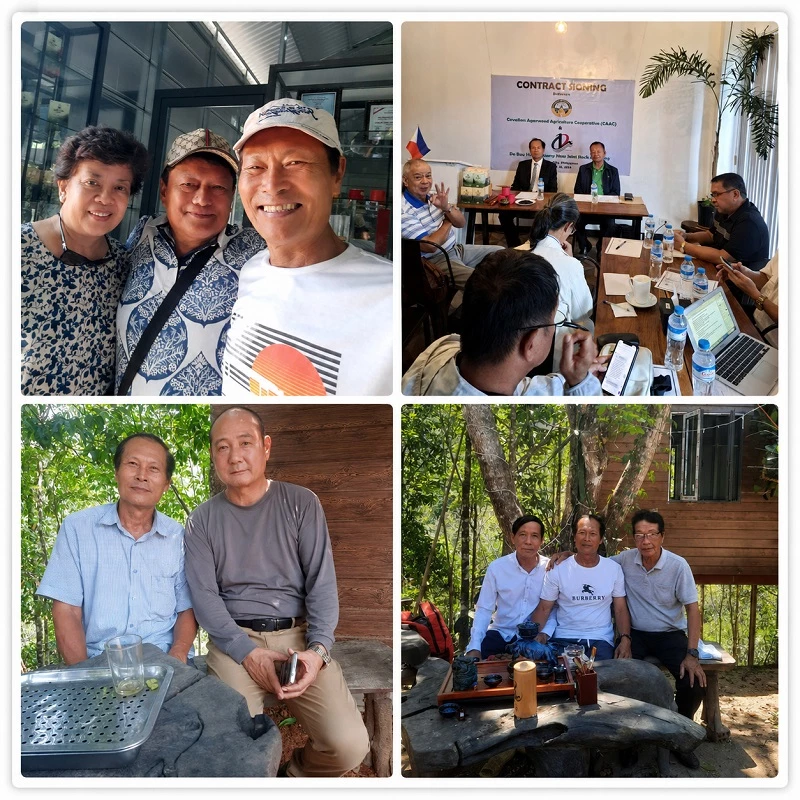
Many international partners are interested in learning about the agarwood oolong tea varieties, the agarwood creation process, and the microbial agarwood creation methods that Mr. Hoang Duy Thanh is developing.
At times, what kept him there wasn't just the expectation of the value of agarwood. It was also a responsibility to the land he had chosen. Behind each patch of trees was the hard work of local laborers. Behind each product was the desire to create more jobs, more income, and another direction for development in this still struggling rural area.
From the Lieng Sronh forest canopy to OCOP products
While waiting for the agarwood trees to mature enough to produce resin, Mr. Thanh didn't let the forest stand still waiting for harvesting. He looked at what the forest already had to find a direction for the future. Agarwood leaves, including old leaves, were studied and processed into various types of agarwood tea. Vine tea growing under the forest canopy was domesticated and developed into a raw material. The roots, trunks, and branches of agarwood, after being cared for and thinned, were utilized to make incense, agarwood cones, and related products.
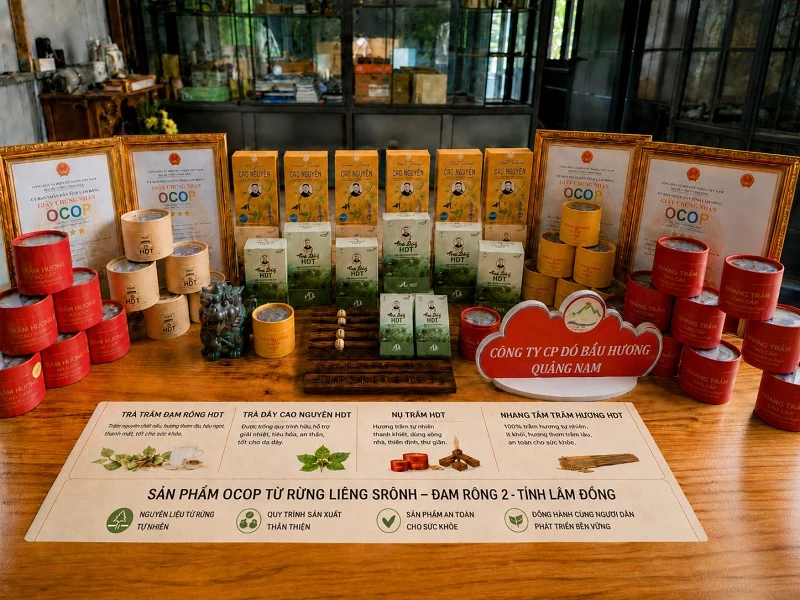
A collection of OCOP products from Quang Nam Agarwood Joint Stock Company.
He said that having become involved with a large raw material area, not a single branch or leaf can be wasted. Experimentation, trial and error, failure, and then trying again are necessary to find the right path. This way of thinking is also the spirit of a true OCOP journey. Products should not only be evaluated and classified, but also standardized from the raw material area, production process, design, to market approach.
From those months of meticulous research, products bearing the mark of the Dam Rong region gradually took shape. HDT Dam Rong Agarwood Tea is associated with the agarwood tree and the unique flavor of the Lieng Sronh forest. HDT Highland Vine Tea inherits the medicinal resources under the forest canopy, closely related to the life and folk knowledge of the mountain people. HDT Agarwood Buds and HDT Agarwood Incense Sticks continue to expand the processing direction, increasing the value of agarwood raw materials.
According to Mr. Thanh, the company's agarwood tea is being developed into various product forms. Some tea lines made from agarwood leaves have already been contracted in principle to supply units outside Hanoi for export in tea bags. The oolong tea in tablet form has also been exported to South Korea and has attracted interest from several partners. These market signals are not the final destination, but they show that products from the Liêng Srônh forest have begun to have opportunities to expand beyond the local area.
Mr. Thanh has repeatedly emphasized that the value of the product lies not only in the processing formula but also in the land itself. Dam Rong 2 has a cool climate, high altitude, a source of water from the headwaters, and a rich natural forest ecosystem. These factors provide the foundation for the development of agarwood trees, tea vines, and other forest products in their own unique way. He believes that the water source, climate, and environmentally friendly production methods are also what contribute to the value of Dam Rong agarwood tea.
In the context of the new rural development program in Dam Rong 2 commune, the model of Quang Nam Agarwood Joint Stock Company offers a noteworthy direction. New rural development is not just about roads, schools, cultural centers, or essential infrastructure. It is also about the capacity for organizing production, how people and businesses exploit local advantages, create livelihoods, and preserve the living environment.
In Liêng Srônh, developing the economy under the forest canopy is no longer a foreign idea. Local workers can participate in planting, caring for, harvesting, processing, and packaging. Forest trees not only provide greenery but also create raw materials. OCOP products are not just goods, but also carry the imprint of the land, water, climate, people, and resilience.
This approach is not limited to businesses; it's gradually spreading to some households. According to Mr. Thanh, in the last three years, some households in Phi Liêng and Đạ K'Nàng have planted agarwood trees after he encouraged and persuaded them. Although the scale is not yet large, this is a noteworthy sign because preserving forests and developing the economy under the forest canopy is only sustainable when local people see opportunities to participate and benefit.
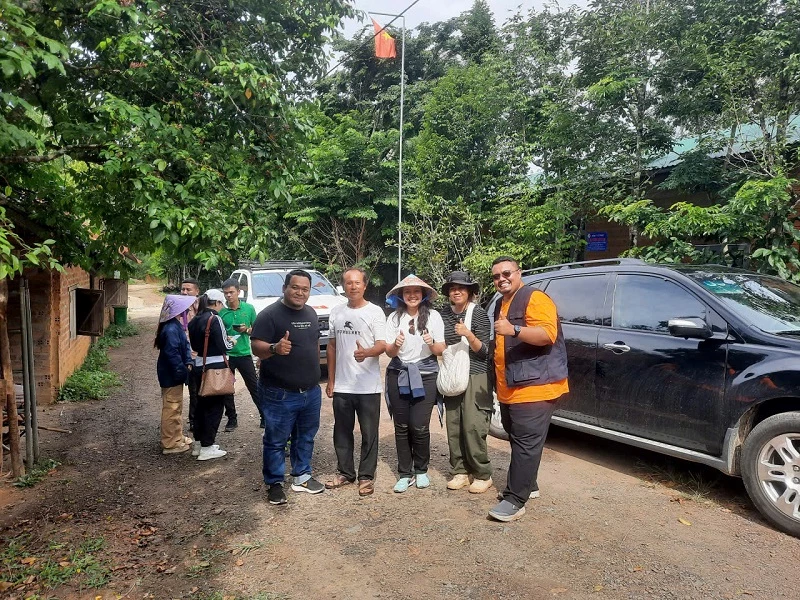
Experts from both Vietnam and abroad have visited, surveyed, researched, and highly appreciated the potential for developing carbon credits from the plantations of Quang Nam Agarwood Joint Stock Company.
However, there is still much work to be done. To go further, the product needs continued investment in quality, design, brand recognition, certification, traceability, and distribution channels. To expand production, the business needs capital, machinery, human resources, and a more stable market connection. Mr. Thanh said the company is selecting a suitable partner to build a factory for distilling agarwood essential oil, while also considering developing agro-tourism and eco-tourism under the forest canopy.
These plans open up new expectations, but also place stricter demands on how we treat forests. If not done carefully, forests can easily be seen as a resource to be exploited. If done systematically, forests can become spaces for livelihoods, experiences, and the preservation of indigenous values. For Mr. Thanh, this direction is only meaningful when the original principles are maintained: products must be clean, trees must survive, forests must become greener, and people living around the forests must have more opportunities to earn a living.
End of content
Không có tin nào tiếp theo