Years of forest stewardship yield OCOP agarwood products in Lieng Sronh
Fortyfying the global supply chain has brought optimistic changes to Viet Nam industrial real estate market / Organizations detecting ransomware decline as the volume and impact of targeted attacks continue to rise
An agarwood dream takes root on depleted hills
Across the hills of Lieng Sronh in Dam Rong 2 Commune, Lam Dong Province, today's stretches of Aquilaria trees represent far more than a green raw material zone. They bear witness to years spent working in the forest, repeated failures and the persistence of Hoang Duy Thanh, who chose this agarwood-bearing tree as the starting point for a journey to produce clean agarwood beneath the forest canopy.
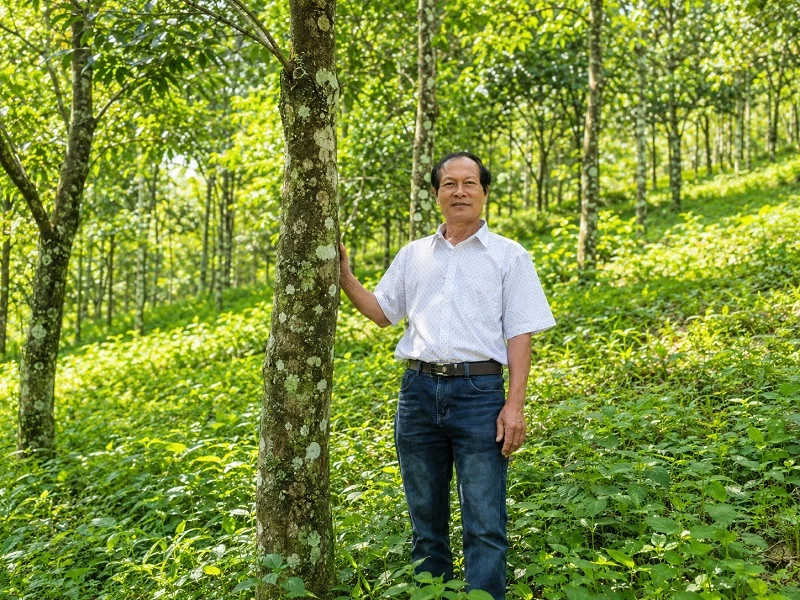
Mr. Hoang Duy Thanh - Quang Nam Agarwood Joint Stock Company, next to an agarwood forest in Lieng Sronh.
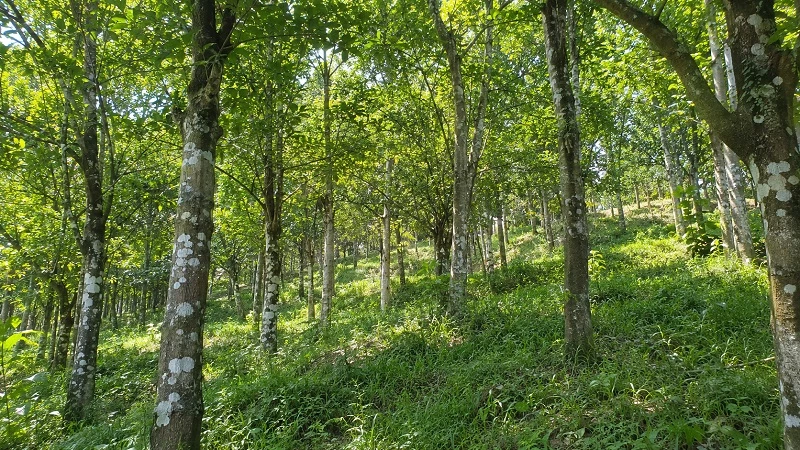
A section of Hoang Duy Thanh's Aquilaria plantation in Lieng Sronh.
Those setbacks shaped Thanh's view of the forest. Reforestation, he believes, cannot be reduced to increasing tree cover at any cost. The trees must survive, the soil must be protected, the ecosystem must be nurtured and the final product must be clean. That conviction is also why he rejects rapid agarwood-induction methods that rely heavily on chemicals.
After seeing bark stripped from trees and chemicals applied to force resin formation, he knew that he could not follow the same path.
"I find that too brutal, and the agarwood produced is not clean," Thanh said. His concern extends beyond the commodity's economic value. To him, producing agarwood also means preserving the integrity of the forest. Agarwood forms through injury to the tree, but that process must not be exploited destructively or at the expense of the environment.
He therefore began exploring more environmentally friendly induction methods, researching microbial preparations, maintaining the forest over the long term and developing raw material zones alongside the conservation of naturally occurring forest trees. Thanh said the company's microbial agarwood-inducing preparation had been tested and found to contain no harmful chemicals. His goal is to produce completely clean agarwood so that every product leaving the Lieng Sronh forest retains the purity of its source.
That philosophy is reflected in practical decisions. Thanh recalled that, after meeting the required compensation obligations for forest resources and receiving approval to salvage timber, he chose to leave the trees standing. When vegetation was cleared to plant Aquilaria, naturally regenerating trees no thicker than an ankle were spared. As the plantation was tended, he found vigorous shoots emerging among the planted trees and set those areas aside for protection and care.
Seventeen years later, many of those small saplings have become mature trees. Some now bear fruit, including wild lychee, chestnut and indigenous bua and ko nia trees. Hunting birds and wildlife is also prohibited in the company's forest. As a result, birds are returning in growing numbers to nest, while flocks of junglefowl have reappeared. In Thanh's model, the forest is not a stock of raw material to be extracted, but an ecosystem to be cared for, replenished and restored.
The challenges have not disappeared. Forest-based products require long lead times, patient capital, reliable techniques and a sufficiently large market. For a business in a remote area, costs associated with processing, labour, packaging, traceability and distribution add further pressure. Establishing a forest is difficult; turning it into a sustainable livelihood is a longer journey still.
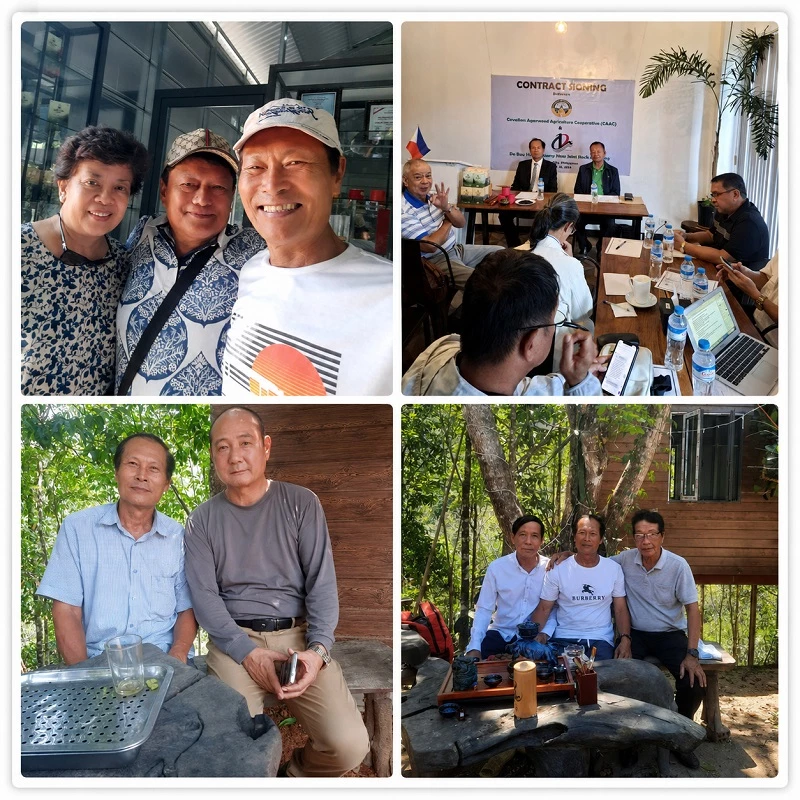
International partners have shown interest in the agarwood oolong teas, agarwood-induction process and microbial methods being developed by Hoang Duy Thanh.
At times, what kept Thanh in Lieng Sronh was not simply the expected value of agarwood, but a sense of responsibility towards the land he had chosen. Each plantation represented the labour of local workers. Each product carried the hope of creating more jobs, raising incomes and opening another path for a rural area that still faces considerable hardship.
From the Lieng Sronh forest canopy to OCOP products
While waiting for the Aquilaria trees to mature and become ready for agarwood induction, Thanh did not allow the forest to stand idle. He looked at what it already offered. Aquilaria leaves, including mature leaves, were studied and processed into several types of tea. Vine tea growing beneath the canopy was domesticated and developed into another raw material source. Roots, trunks and branches obtained through tending and thinning were used to make incense sticks, agarwood incense cones and related products.
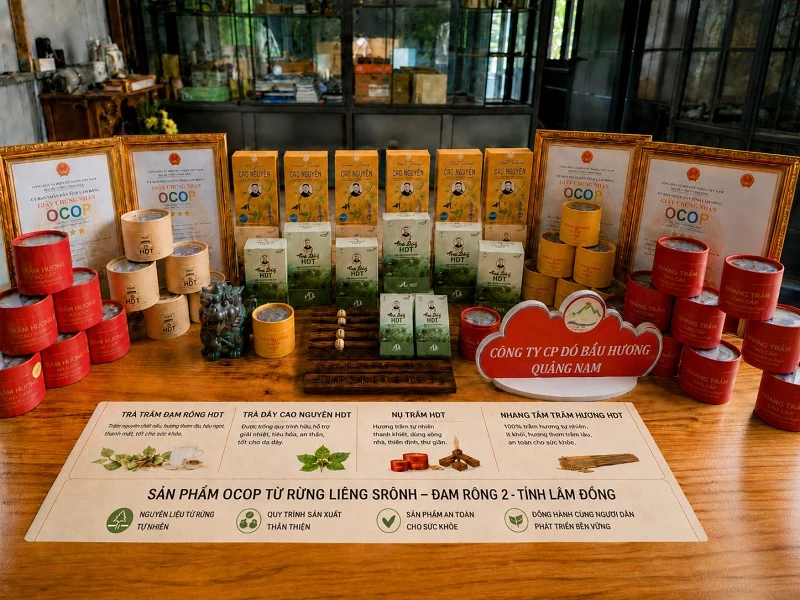
A collection of OCOP products developed by Do Bau Huong Quang Nam Joint Stock Company.
Thanh said that once a business becomes responsible for a large raw material zone, not a single branch or leaf should be wasted. Finding the right direction requires experimentation, trial and error, failure and another attempt. That mindset also captures the spirit of a genuine OCOP journey. Products should not merely be submitted for assessment and star classification; raw material zones, production processes, packaging and market access must all be standardised.
Out of this patient experimentation, products bearing the identity of Dam Rong gradually took shape. HDT Dam Rong Agarwood Tea combines the Aquilaria tree with the distinctive character of the Lieng Sronh forest. HDT Highland Vine Tea draws on medicinal plants beneath the canopy and on the everyday knowledge of mountain communities. HDT Agarwood Incense Cones and HDT Agarwood Incense Sticks extend the company's processing range and add value to agarwood materials.
According to Thanh, the company is developing its agarwood tea in several formats. It has signed an agreement in principle to supply certain Aquilaria-leaf teas to a company outside Hanoi for processing into tea bags for export. Its compressed oolong tea has already been exported to South Korea and has attracted interest from several partners. These market signals are not an end point, but they suggest that products from the Lieng Sronh forest are beginning to find opportunities beyond the locality.
Thanh repeatedly stresses that a product's value begins not only with its processing formula, but with the land itself. Dam Rong 2 has a cool climate, high elevation, headwater sources and a rich natural forest ecosystem. Together, these conditions offer a distinctive foundation for Aquilaria, vine tea and other forest products. He believes the water, climate and environmentally responsible production methods all contribute to the value of Dam Rong agarwood tea.
Within Dam Rong 2's new-style rural development programme, the company's model points to a noteworthy direction. New-style rural development is not only visible in roads, schools, community centres and essential infrastructure. It is also measured by the ability to organise production, use local advantages, create livelihoods and protect the living environment.
In Lieng Sronh, a forest-canopy economy is no longer a distant concept. Local workers can take part in planting, tending, harvesting, primary processing and packaging. Forest trees provide more than green cover; they also supply raw materials. OCOP products are more than merchandise: they carry the imprint of the land, water, climate, people and persistence that created them.
The approach is also beginning to spread beyond the company. Thanh said that, over the past three years, several households in Phi Lieng and Da K'Nang had planted Aquilaria after he encouraged them to do so. The scale remains modest, but the change is significant. Forest conservation and economic activity beneath the canopy can be sustainable only when local people see a real opportunity to participate and benefit.
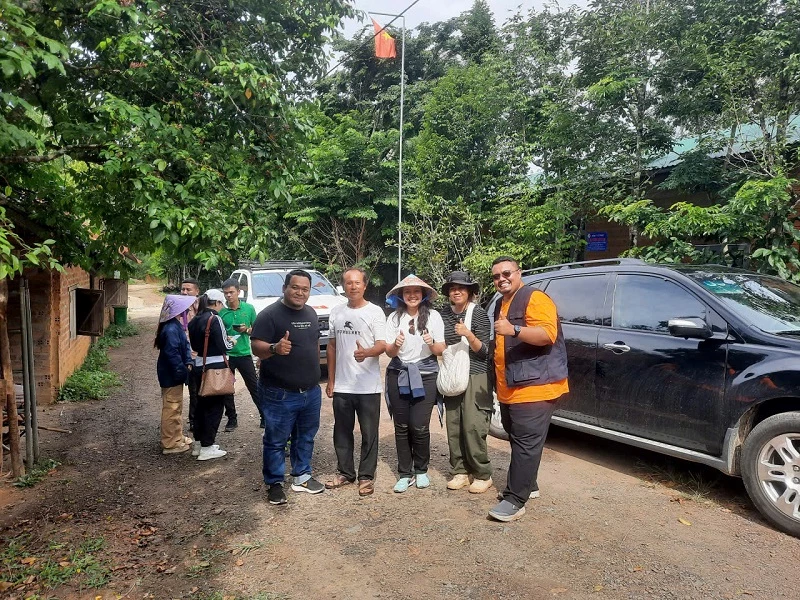
Vietnamese and international experts have surveyed the company's planted forests and highlighted their potential for developing carbon credits.
Much work remains. Products will require continued investment in quality, design, brand recognition, certification, traceability and distribution. Expanding production will require capital, machinery, skilled people and more stable market connections. Thanh said the company was selecting a suitable partner for an agarwood essential-oil distillation plant, while also considering agri-tourism and ecotourism beneath the forest canopy.
Those plans create new expectations, but they also impose stricter demands on how the forest is treated. Poorly managed, it can easily be reduced to a resource for extraction. Developed systematically, it can become a space for livelihoods and visitor experiences while preserving indigenous values. For Thanh, that direction is meaningful only if the original principles remain intact: products must be clean, trees must survive, the forest must become greener and communities living around it must have more opportunities to earn a living.
End of content
Không có tin nào tiếp theo